


Information Disclosure Based on TCFD Recommendations
In June 2022, the Company announced its support for the recommendations of the Task Force on Climate-related Financial Disclosures (TCFD). In line with the TCFD recommendations, we will disclose important information on climate change as follows.

Strategies (Risks and opportunities)
In order to understand the impact of climate change on the Group business, we have analyzed risks and opportunities for all businesses in the Group using the following two scenarios:
- The “1.5°C scenario,” in which global temperature rise at the end of the 21st century is kept below 1.5°C and the transition to a decarbonized society is realized
- The “4°C scenario,” in which measures against global warming that surpass the current level are not taken and physical effects are assumed
[Important risks and opportunities]
We identified risks and opportunities for climate change and examined the importance of climate change to the Group and when it might occur.
- Time axis (time of occurrence) – Short term: By around 2025, Medium term: By around 2030, Long term: By around 2050
- Materiality (potential impacts on strategic and financial plans, etc.) – Large: Large impact, Medium: Moderate impact range, Small: Little impact on the Company
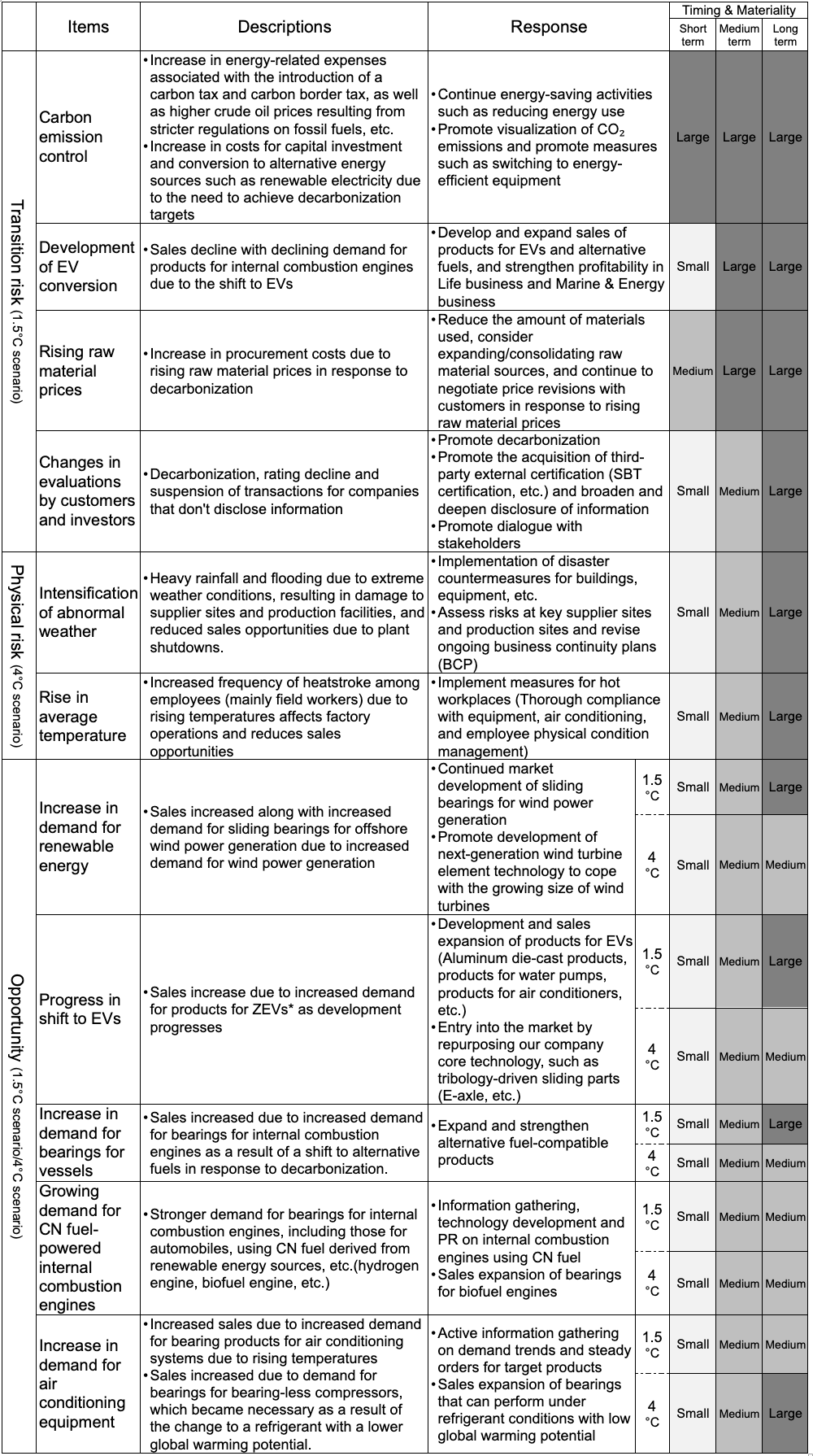
*ZEVs (Zero-Emission Vehicle): Battery electric vehicles (BEV) and fuel cell vehicles (FCV) that do not emit carbon dioxide or other exhaust gases when running
[Policy on climate change risks and opportunities]
The Group will use scenario analysis to identify medium- to long-term risks and opportunities, analyze the impact of its management strategy and financial position, and take measures to respond appropriately to risks, strengthen its competitiveness against opportunities, and acquire new business opportunities. The results will be disclosed and reported to stakeholders through media such as the Company website and integrated reports.
>New Midterm Business Plan 2025–2030 “Bridge to Daido 2030”
[Future direction of management]
Our Group has positioned the manufacturing and sale of bearings around engines, employed for automobiles and ships, as its core business. Further leveraging the strengths of technology, manufacturing expertise, the quality that generates trust and security and the business foundation, all of which we have long cultivated through the business of bearings around engines, we will push forward with our business, centered on an omnidirectional strategy (a multi-pathway strategy) that can keep fulfilling customer needs, including a wide lineup of engine bearings and the capability to respond to environmental load. On top of this, we will strive to expand and deepen sales of products used in fields other than those around engines and put specific strategies in motion on a rolling basis, thereby raising the weight of each business other than “parts around engines” and “automobiles and ships.” We will expand and reinforce the business foundation while broadening and deepening domains other than plain bearings by offering the value of plain bearings to not only the traditional fields of automobiles and ships but also a wide range of industries in general.
In parallel, our Group will also strive to unearth the new social value of plain bearings in a consistent and scheduled manner to build a foothold for the future. We are making the most of our core technologies cultivated over many years, and as a contribution to green energy, are continuing to actively develop the market for bearings for wind power generation, for which demand is expected to grow in the renewable energy field. We constructed a building to run experiments at Daido Metal Saga Co., Ltd. (in Takeo City, Saga Prefecture), a consolidated subsidiary of the Company, with the aim of enhancing the design reliability of large windmill plain bearings and started operating it in May 2025. Plain bearing bench testing machines have been installed in the experiment building, which is the world’s first installation of plain bearing bench testing machines by a bearing manufacturer on its own. There, we will proceed with the development of windmill plain bearings in cooperation with Saga University and the National Institute of Advanced Industrial Science and Technology.
Through the above measures, we will contribute to the realization of carbon neutrality.
Metrics and Targets
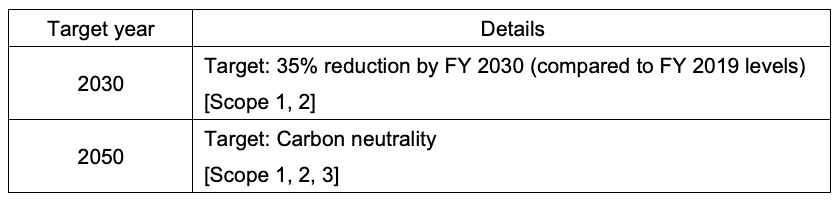
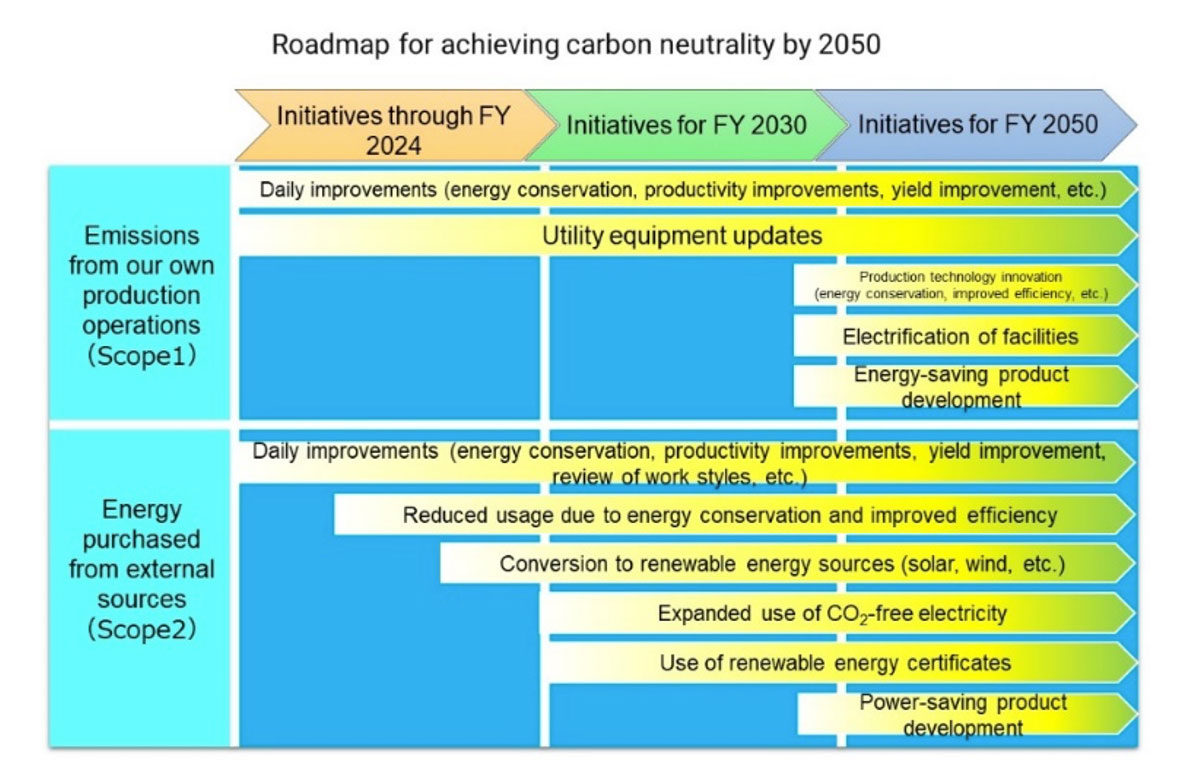
In light of the recent rise in environmental awareness and the Japanese government’s move to become carbon neutral in 2050, our Group has formulated our carbon neutral policy. In order to fulfill our responsibilities as a member of the global community, we have set a long-term target of achieving carbon neutrality (Scope 1, 2, 3) across our Group by 2050. We have also set an interim target—a 35% reduction (Scope 1 and 2) of net CO₂ emissions compared to FY 2019 levels—for the entire Group by 2030. We have created a roadmap to achieve our 2050 carbon neutrality target and will work to reduce CO₂ emissions in phases.
Specifically, we will promote energy-saving measures and the expansion of the use of renewable energy, as well as the visualization of CO2 emissions by business site, plant and equipment, and will prioritize and target measures based on the calculation of costs for equipment measures.
And we will work with suppliers to reduce CO2 emissions not only from our own operations (Scope 1, 2) but also throughout the entire supply chain (Scope 3) by first expanding the scope of emissions calculations.
For the results of CO2 emissions (Scope 1, 2, 3), please see the Company’s website.
>ESG Data
>Environmental Management
>Addressing Climate Change
[CO₂ Emissions Reduction Targets]
– Medium- to long-term targets

© 2026 Daido Metal Co., Ltd. All Rights Reserved.